

A lineage worth understanding
The 19th century gave rise to the Industrial Revolution, an era of unprecedented change, complexity, and opportunity. It also introduced Frederick Winslow Taylor, widely regarded as the father of scientific management. Through his pioneering time-and-motion studies, Taylor transformed factory efficiency and established principles that would become foundational to modern consulting. His belief in systematic analysis, measurement, and optimisation continues to influence how organisations improve performance today.
Not far from where this was written, another important chapter in consulting history began. In 1914, Booz Allen was founded near Northwestern University, becoming one of the world's first management consulting firms. A little over a decade later, McKinsey & Company was established in Chicago by James O. McKinsey, an accounting professor at the University of Chicago. It is remarkable how much of the consulting industry's DNA traces back to Chicago and to the academic community — early firms founded by professors who brought structured thinking and analytical rigour into the business world.
A century later, it feels both timely and fitting that a new kind of consultancy is once again emerging from Chicago. But this time, the model is different.
Why we built something different
This consultancy was not conceived in a university classroom. It was forged through the practical realities of enterprise transformation — more than two decades spent helping organisations navigate waves of digitisation, operationalise emerging technologies, and create measurable business value. It comes from working deep inside companies, understanding what makes change stick, witnessing how technology decisions are made, and seeing firsthand how the influence of large technology vendors can shape leadership priorities.
Yet the motivation for building something different runs deeper than professional experience.
At its heart is a simple belief: world-class consulting should not be reserved exclusively for the largest enterprises with the biggest budgets. Many organisations that could benefit most from strategic guidance simply cannot afford traditional consulting engagements. By leveraging AI, we now have the opportunity to change that. More importantly, we can help create greater economic prosperity within those organisations and the communities they support.
It should not be the case that the financial rewards of innovation flow only to a small number of technology companies and their ecosystems. Technology, when developed and deployed thoughtfully, can be a great equaliser. At its best, it democratises access, opportunity, and abundance.
The problem with the existing model
The rise of big tech transformed consulting. As enterprises raced to modernise, consultants became key advisors on technology strategy and digital transformation. Yet it also created a new reality: many firms became increasingly aligned with the platforms they recommended. Over time, independence gave way to ecosystem economics, and the interests of clients and technology providers did not always perfectly align.
Today, AI offers an opportunity to reimagine that model.
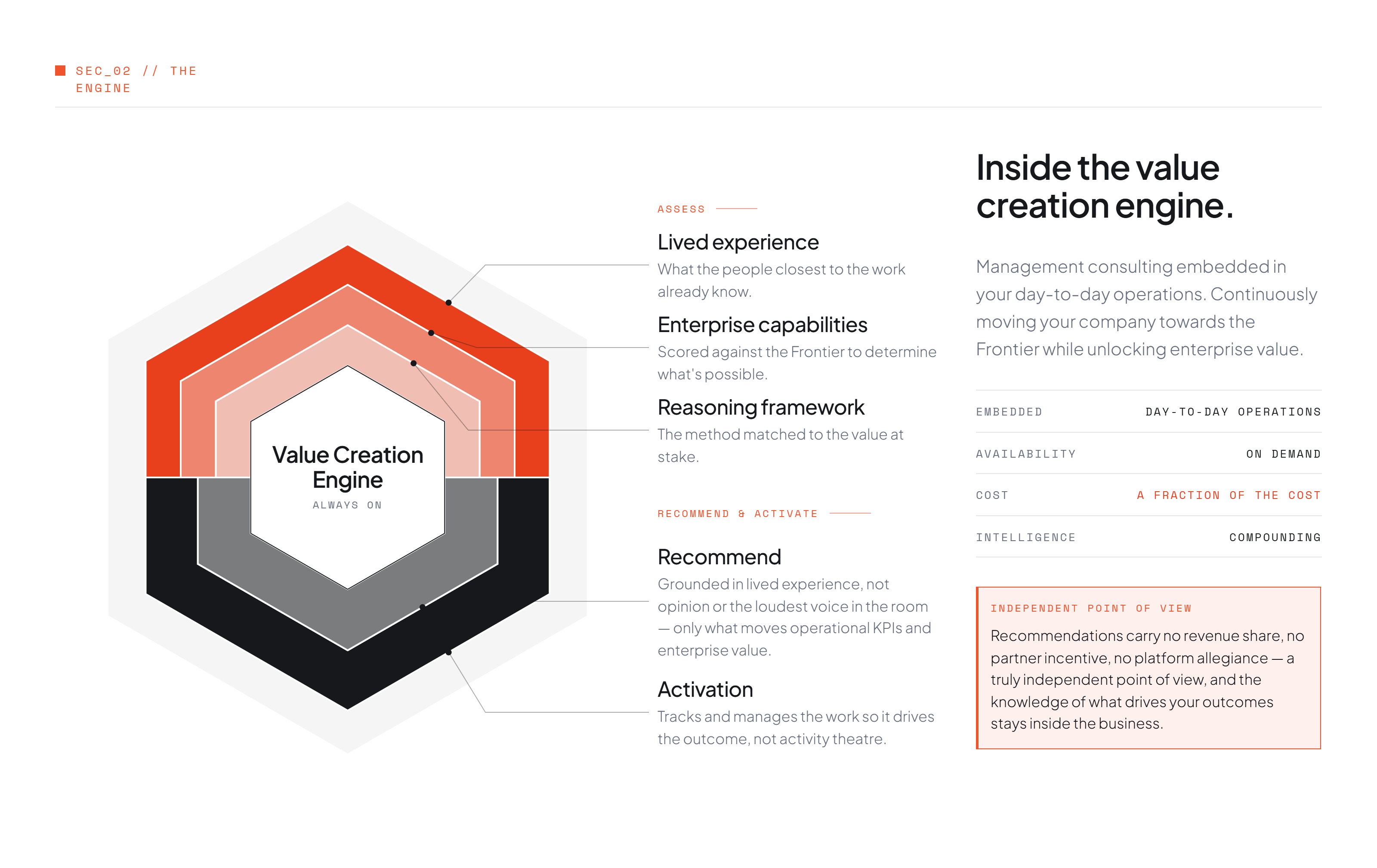
For the first time, we can embed consulting expertise directly within a company. The frameworks, analytical capabilities, institutional knowledge, and strategic guidance that once arrived through periodic engagements can now live inside the organisation itself. It is a consultant that never leaves. A capability that continuously learns, adapts, and supports decision-making from within.
Equally important, it is independent. Its recommendations are not shaped by revenue-sharing agreements, partner incentives, or the pressures that often accompany large technology ecosystems. Its purpose is singular: to help organisations make the best decisions for their business.
Lived Experience as the foundation
Our Enterprise Value Engine is grounded in Lived Experience: the knowledge gained through direct involvement in the work, the decisions, and the everyday realities of the business. It is the insight that comes from those closest to the problem — not from assumptions, frameworks, or second-hand interpretations.
We believe AI should be designed to uncover and amplify that lived experience by understanding people's goals, intent, and context. When technology is grounded in the knowledge that already exists within the organisation, it delivers insights that are more relevant, actionable, and valuable.
More importantly, lived experience helps prevent what we call synthetic drift: the growing disconnect between decision-making and the realities of the people doing the work. As organisations become larger and more complex, decisions can become increasingly driven by abstractions, processes, and models rather than human insight and operational reality.
We believe synthetic drift is a root cause of much of the frustration, inefficiency, and disengagement seen across large enterprises today. By keeping lived experience at the centre of strategy, transformation, and AI, organisations can stay connected to what matters most: their people, their customers, and the realities that drive sustainable value creation.
Green Project, Red Outcome
Think about how often a project can be declared a success on paper while failing to deliver the result that actually mattered. The scope was defined, the milestones were met, the status reports stayed green, and the consultants did exactly what they said they would do. Yet the business outcome never materialised.
We call this phenomenon Green Project, Red Outcome.
Too often, organisations measure success by activity rather than impact. The project gets completed, but margins don't improve. The transformation launches, but revenue doesn't grow. The initiative closes on time, but enterprise value remains unchanged.
The time for engagement theatre is over.
Our Enterprise Value Engine ensures every recommendation, decision, and action is directly connected to a measurable outcome. Whether the goal is an operational metric — margin expansion, productivity improvement, revenue growth — or an investor-focused metric such as Enterprise Value, the engine maintains a clear line of sight from execution to impact. Because in the end, success isn't defined by what was delivered. It's defined by the value that was created.
The knowledge that stays
Perhaps most importantly: the knowledge stays.
The insights into what works, what doesn't, and why are not captured in a report that sits on a shelf or walks out the door when an engagement ends. Instead, that knowledge becomes a permanent asset of the organisation. The institutional wisdom, operational learnings, and pattern recognition gained over time are continuously retained, refined, and expanded.
When combined with consulting-grade expertise, this creates a powerful compounding effect. The capability is always on, always available, and continuously learning from the business. There is no need to repeatedly engage different consultants to address different parts of the organisation, or to restart the learning process with every new initiative.
The best part is that the knowledge never leaves. It accumulates, grows more valuable over time, and becomes a strategic advantage unique to your organisation.
That is what we believe is the next frontier of consulting: not renting expertise for a moment in time, but building a capability that compounds in value every day — at a fraction of the cost.
The opportunity ahead isn't just to improve performance. It's to create an organisation that continuously learns, adapts, and grows stronger over time. If that vision resonates with you, we'd welcome the opportunity to start the conversation.